Online Booking Systems: When Is a Custom Solution Worth It?
An online booking system helps businesses manage availability, confirm appointments and organise customer services. Learn when an existing booking platform is sufficient and when developing a custom solution makes better business sense.
By Serginho 12 min read Updated November 11, 2026
In this article
- What is an online booking system?
- When manual booking processes become a problem
- The benefits of accepting bookings through your website
- Custom booking software or a subscription-based platform?
- Online booking systems for hotels and accommodation providers
- Online appointment scheduling for medical clinics and professional services
- Integrating bookings with Stripe, PayPal and other payment providers
- Automated booking confirmations and appointment reminders
- Managing cancellations, changes and availability
- What features should an online booking system include?
- How much does custom booking system development cost?
- When is a custom booking solution worth developing?
A business that receives bookings by telephone, WhatsApp or email can usually manage requests without major difficulties while customer numbers remain relatively low. However, as demand increases, several activities begin to consume more time: checking availability, answering repetitive questions, changing appointments, recording cancellations and verifying whether a booking has been paid for.
This situation affects businesses across different industries, including hotels, medical clinics, beauty centres, tourism operators and companies offering appointment-based services. Although their operations differ, they share a common requirement: maintaining accurate information about the times, professionals, facilities or services available to customers.
An online booking system helps organise these processes by allowing customers to check availability and make reservations directly through a business website. Depending on the company's requirements, the solution may be an existing subscription-based platform or an application developed specifically for its operations.
The decision to develop a custom booking system should consider booking volumes, business rules, sales channels and integration requirements. Not every business needs to build its own platform, but not every existing solution can accommodate specialised operational procedures.
What is an online booking system?
An online booking system is an application that allows customers to check availability, select dates or times and submit requests for appointments or services. It can operate directly within a company's website or through an external platform responsible for managing bookings.
A basic system may display available times, collect customer details and send confirmations. More advanced solutions can include advance payments, cancellation policies, staff allocation, resource management, promotional offers and automated communications.
For example, a medical clinic may offer appointments across several specialities, each requiring different consultation times and qualified professionals. The system must consider these factors before displaying available appointments. A company renting event spaces, on the other hand, needs to manage availability according to facilities, booking dates and the time required to prepare each venue.
These differences explain why an online booking system involves more than simply adding a calendar to a website. To operate effectively, it must reflect the actual conditions under which the business provides its services.
When manual booking processes become a problem
Manual booking management can work effectively for a considerable period, particularly when a business offers a limited number of services and receives relatively few daily reservations. Problems arise when employees begin spending a significant proportion of their working hours checking information that customers could access independently.
A common situation occurs when someone enquires about availability through WhatsApp, receives a response and takes several hours to confirm. During that period, another customer may request the same appointment. Without a centralised and updated record, the business risks confirming two bookings for the same professional or resource.
Errors can also occur when several employees manage appointments. A reservation recorded in one calendar may not appear in another, a cancellation may not be updated immediately, or a change of appointment may only be communicated to one member of staff.
Beyond the administrative workload, these situations affect the customer experience. Someone who wants to schedule a medical appointment or book a service outside normal business hours may abandon the process if they must wait until the following day to check availability.
When these difficulties become frequent, introducing an online booking system can help organise operations and reduce dependence on manual confirmations.
The benefits of accepting bookings through your website
Allowing customers to make reservations directly through a website makes services more accessible without requiring an employee to be available to answer every enquiry.
Customers can review available appointments, select the service they need and complete their booking using a smartphone or computer. If the system supports automated confirmations, they can also receive their booking details without waiting for a manual response.
For the business, this creates a centralised record of incoming reservations. Employees can review upcoming appointments, identify changes and organise the resources needed to provide each service.
Another advantage is the opportunity to present additional services during the booking process. A hotel might offer optional extras, while a tourism company could display different activities, departure times or arrangements for groups.
However, introducing online bookings does not automatically increase sales. Results also depend on how clearly services are presented, how easy the booking process is to complete, the trust customers place in the website and the actual availability of the services offered.
Custom booking software or a subscription-based platform?
Numerous commercial platforms allow businesses to add online booking functionality to their websites through a subscription. For organisations with relatively standard procedures, these tools may meet their requirements without a substantial investment in software development.
For example, an independent professional offering consultations of a fixed duration may find an existing appointment scheduling application sufficient. If the main requirements are displaying availability, accepting bookings and sending reminders, several established solutions may already provide these features.
Developing a custom booking system becomes more relevant when business rules require specific functionality. This may occur when availability depends on several resources, commercial conditions vary between customers or reservations need to interact with other internal processes.
A custom solution may also be appropriate when a company needs to manage multiple locations, integrate bookings with an existing management system or establish particular payment and confirmation procedures.
The comparison should consider initial costs, subscription fees, transaction charges where applicable, maintenance and future expansion. A commercial platform may remain suitable for many years, while custom development becomes more attractive when it addresses requirements that existing products cannot accommodate.
Online booking systems for hotels and accommodation providers
In the accommodation industry, booking systems must account for arrival and departure dates, room categories, occupancy, rates and booking conditions. Unlike an appointment calendar, availability depends on continuous periods and the capacity of each property.
A hotel or accommodation provider can incorporate a booking engine into its website to receive direct reservations. This provides an additional sales channel alongside external distribution platforms.
However, properties that also advertise availability through online travel agencies must keep information synchronised across their sales channels. Where there is a risk of selling the same room more than once, integration with a property management system or channel manager becomes particularly important.
Developing a custom booking engine does not automatically eliminate the need for these tools. Before implementation, businesses should verify available integrations and determine how rates, availability and booking modifications will be managed.
For accommodation providers with specialised requirements, a custom application may incorporate additional services, negotiated arrangements for corporate customers or groups, and booking procedures that standard platforms do not always support.
Online appointment scheduling for medical clinics and professional services
Businesses offering scheduled appointments need to manage availability differently from hotels and accommodation providers. In these cases, the system must consider the duration of each service, staff schedules and, where necessary, the physical resources required for an appointment.
A medical clinic, for example, may offer consultations across several specialities, with healthcare professionals working on specific days and at particular times. If consultation rooms or equipment are shared between services, the application must prevent incompatible appointments from being scheduled simultaneously.
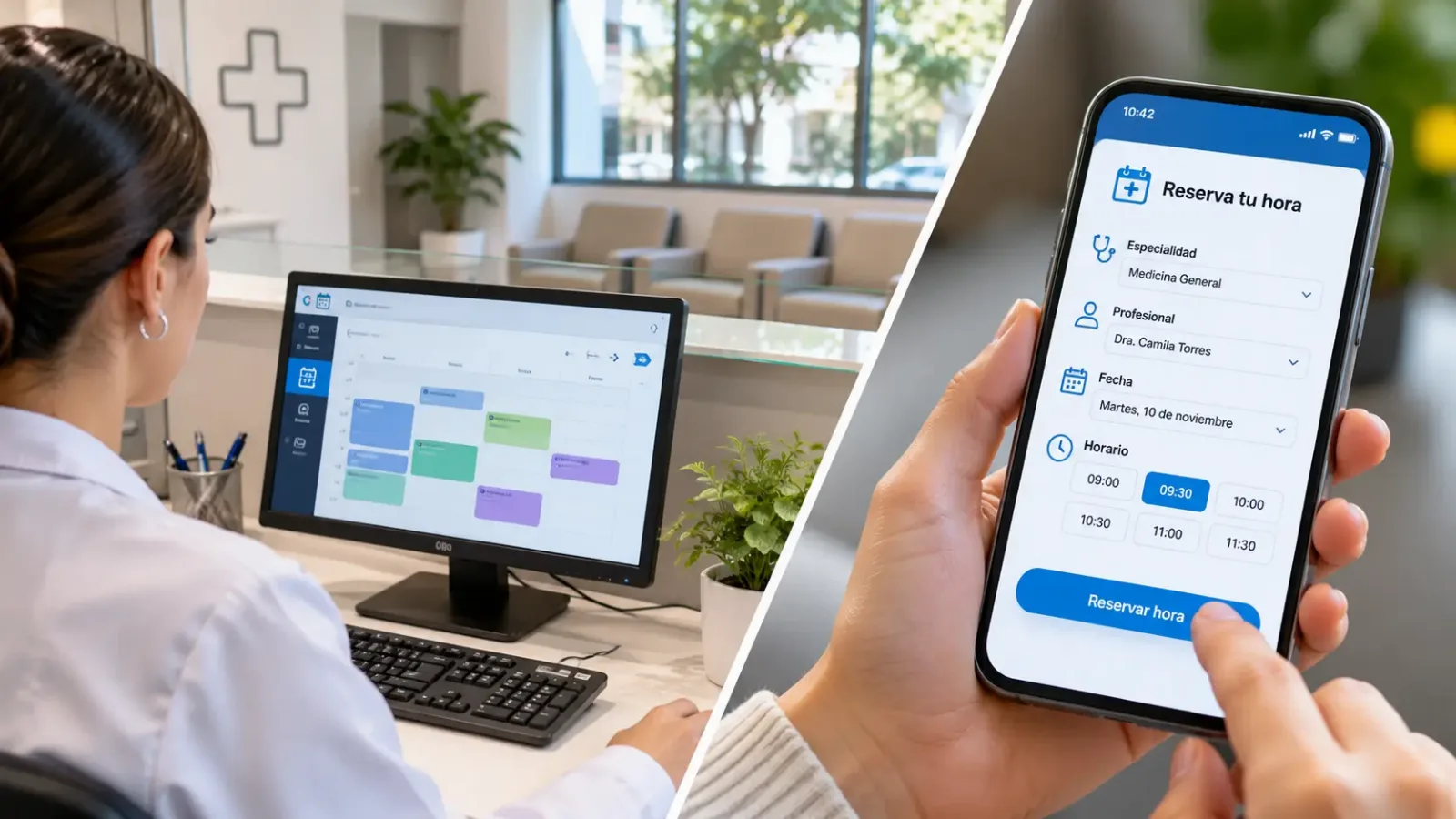
An appointment booking system can also allow patients to select a medical speciality, choose a healthcare professional, review available times and receive confirmation directly on their smartphones. For reception staff, information is organised in a centralised calendar, making it easier to manage consultations, cancellations and rescheduling.
Healthcare organisations must also consider specific requirements relating to personal information and patient records. Depending on the country, health-related information may be subject to additional data protection obligations, including restrictions on access, storage and processing.
For this reason, choosing an appointment scheduling platform should involve more than evaluating the patient experience. Internal workflows, access permissions and information security are equally important.
Integrating bookings with Stripe, PayPal and other payment providers
Some businesses require a deposit or full payment before confirming a reservation. This can help manage services involving advance preparation, limited availability or the exclusive allocation of resources.
Integrating a booking system with payment providers such as Stripe, PayPal or other supported services allows customers to complete transactions during the reservation process. Once payment has been verified, the system can update the booking status and send the appropriate confirmation.
However, the process must account for pending payments, declined transactions, cancellations and refunds. It is also important to prevent repeated payment notifications from creating duplicate confirmations.
Commercial conditions should be clearly established. If a reservation requires a non-refundable deposit, permits changes until a particular deadline or includes cancellation charges, these conditions should be communicated before the customer completes the booking and must comply with applicable regulations.
Payment integration should reflect the actual needs of the business. Not every organisation requires advance payments, and in some cases, registering the appointment and collecting payment when the service is provided may be sufficient.
Automated booking confirmations and appointment reminders
A significant part of booking administration involves communicating information that has already been recorded: dates, times, locations, service conditions and possible changes.
A booking system can automate these communications through email and, where supported integrations and permissions allow, WhatsApp or other messaging channels. For example, after confirming a medical appointment, a patient could receive a message containing the consultation date, time, clinic address and relevant instructions.
Reminders can also be scheduled before an appointment. For businesses operating with fixed time slots, these messages can help customers remember their commitments and provide information about requesting changes.
However, automated communications must reflect the latest booking details. If an appointment is rescheduled, the system should use the updated information to avoid sending incorrect reminders.
Automation should simplify communication rather than generate unnecessary messages. Frequency, content and delivery channels should be determined according to the type of service and customer preferences.
Managing cancellations, changes and availability
An online booking system must account for what happens after a reservation is submitted. Customers may change dates, cancel services or need alternatives when their preferred appointment is no longer available.
For this reason, it is important to define different booking statuses. A request awaiting payment should not necessarily be treated in the same way as a confirmed appointment, while a cancellation may release availability for other customers.
Specific rules may also apply. A company might allow changes until a particular deadline, require approval for certain modifications or temporarily hold an appointment while the customer completes payment.
These conditions need to be reflected in the application's functionality. If the system does not accommodate the business's actual operating rules, employees will end up maintaining separate procedures to correct situations that should be managed within the platform.
Before developing or purchasing a solution, businesses should examine how changes are currently handled and identify the exceptions that occur most frequently.
What features should an online booking system include?
The necessary features depend on the type of business, but several considerations apply to almost every implementation.
The first is availability management. The system should display appointments or services that can genuinely be booked and update the relevant times or resources when a reservation is confirmed. Authorised employees should also be able to review this information through an administrative dashboard.
User experience is another important factor. A booking process involving too many steps, unnecessary information requests or difficulties on mobile devices can cause customers to abandon their reservations before completion.
Businesses should also consider confirmations, modifications, cancellations, user permissions and access to booking histories. Where advance payments are required, suitable payment integrations should be included.
Security and operational continuity are also part of the project. Customer information must be protected, access permissions controlled and mechanisms established to detect failures or restore operations following an interruption.
An application with a large number of features is not necessarily the best solution. What matters is whether it reliably supports the processes the business needs to manage.
How much does custom booking system development cost?
Development costs depend on the project's scope. An application designed to manage appointments at a single location has different requirements from a platform coordinating multiple branches, professionals, resources, variable pricing, payments and external systems.
Factors influencing the investment include the number of booking types, availability rules, user roles, integrations and customer communication mechanisms. The booking experience, administrative dashboard and testing requirements must also be considered.
Beyond initial development, a custom platform requires hosting, maintenance, security updates and support. These ongoing costs should be included from the beginning so that the project is financially sustainable beyond its initial implementation.
Before requesting a quotation, businesses should describe how reservations are currently received, who manages them, which conditions must be met and what operational difficulties occur most frequently. This information makes it possible to define an initial scope and assess whether custom development or an existing platform is more appropriate.
When is a custom booking solution worth developing?
A custom booking system may be worthwhile when a business needs to manage procedures that existing platforms cannot support, integrate reservations with other applications or provide specialised functionality for its customers.
It may also be appropriate when the organisation wants to develop a digital sales channel that forms part of its wider operations and can evolve as requirements change. In these situations, the project should consider both the customer booking experience and the tools employees need to manage reservations internally.
At DodoLab, we develop web applications, business management systems and integrations for organisations looking to improve their operations and deliver digital services. A booking platform can begin with essential functionality and expand over time, provided its technical architecture supports future requirements.
The decision should not be based solely on the appeal of owning a custom platform. A booking system delivers business value when it reduces administrative work, improves availability management and makes services easier to book.
For some businesses, an established commercial platform will be sufficient. For others, a custom application will provide the flexibility needed to manage specialised requirements and connect bookings with the rest of their operations. The most appropriate choice is the one that meets the organisation's needs with sustainable development and maintenance costs.
Frequently asked questions
1. Is it better to use an existing booking platform or develop a custom system?
It depends on the business's requirements. An existing platform is often suitable when booking procedures are standard and its features support daily operations. Custom development may be preferable when specialised rules, multiple resources or integrations are required.
2. Can an online booking system integrate with Stripe or PayPal?
Yes. When compatible integration mechanisms are available, booking systems can accept deposits or full payments and update reservation statuses after transactions have been verified.
3. Can an online booking system be added to an existing website?
Yes. Depending on the website's technology and the booking solution, functionality can be incorporated through an integration, a dedicated module or a connected application. Rebuilding the entire website is not always necessary.
Was this article helpful?
Get an assessment